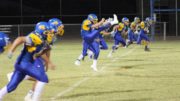
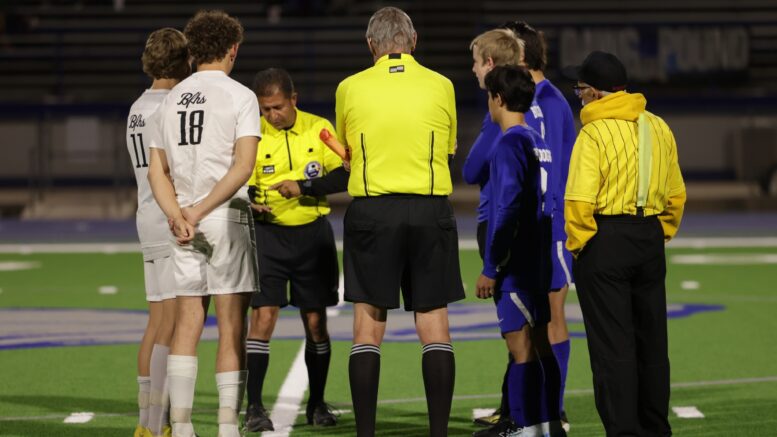


With more games and fewer whistles, the challenge to staff Arizona prep sports quietly continues.
High school sports in Arizona are just weeks away from kicking off another season. Soon, Friday night lights will return, gymnasiums will be buzzing, and cross-country trails will be packed. But while the focus often falls on student-athletes and coaches, there’s another group getting ready behind the scenes—officials. And while the national numbers paint a promising picture of recovery, Arizona’s story comes with its own set of hurdles.
We don’t often tell stories about referees. Athletes get the highlights, coaches get the interviews, and when officials are mentioned, it’s usually for a call someone didn’t like. But these are the people who keep the game moving, night after night, in every corner of the state. So today, we’re pulling back the curtain a little—with the help of Brian Gessner, Commissioner of Officials for the Arizona Interscholastic Association (AIA).
This year, the National Federation of State High School Associations reported a 6% increase in officiating registrations across 36 states. The total number of registered high school sports officials is now above pre-pandemic levels—an impressive rebound from the COVID-era lows. But according to Gessner, the state still finds itself playing catch-up.
“Arizona is a growth state,” Gessner explained. “More schools, more games, and the need for more officials.” While overall participation is on the rise, that growth brings more strain to a system that’s already running lean. Veteran officials are working more games than ever, and rural areas are still struggling to field enough referees to keep contests running on schedule.
Gessner says the AIA has launched an aggressive, multi-front approach to tackling the officiating shortage. Recruiting, in his words, is a “shotgun approach” aimed at drawing interest from universities, junior colleges, school districts, first responders, and beyond. The campaign includes a full-scale media blitz across radio, print, TV, social media, and signage. But the most successful method so far hasn’t come from billboards or hashtags—it’s come from within. The AIA’s internal incentive program, driven by current officials recruiting others into the fold, has yielded the strongest results.
Retention, on the other hand, requires more precision. Every first, second, and third-year official in Arizona is contacted multiple times throughout the season, not just for administrative check-ins but to make sure they’re supported and improving. They’re paired with veteran mentors, scheduled alongside experienced crews, and evaluated regularly.
“We want to make sure they don’t just survive the season—we want them to succeed and come back,” Gessner said. Veteran officials also receive ongoing support to help identify and resolve issues before they lead to burnout or attrition.
Still, even with better recruitment and mentorship, there’s one factor that continues to drive people away before they ever pick up a whistle: the environment. Gessner doesn’t sugarcoat it.
“Absolutely! This is the number one reason why people won’t enter the avocation—because of the environment,” he said. “‘No way! I don’t want to be yelled at like that!’”
Verbal abuse and poor sideline behavior—mostly from adults—continue to plague youth and high school sports across the country, and Arizona is no exception.
In response, the AIA has made sportsmanship a central point of emphasis. This past year, the association increased the penalties for unsportsmanlike conduct from coaches and players, which led to a measurable decrease in ejections. Some school districts are going even further, implementing their own policies with additional consequences. To recognize those who get it right, the AIA recently introduced the Copper Star Award, which honors schools that demonstrate exceptional sportsmanship throughout the season.
Athletic directors right here in southeastern Arizona are seeing the strain firsthand. At Safford High School, Assistant Principal and Athletic Director Ryan Scherling says the shortage has forced schools to adapt—sometimes in ways that directly affect the games themselves. In recent seasons, his teams have played varsity basketball with only two referees instead of the standard three, and varsity softball with just one umpire on the field.
Rescheduling and improvising have become part of the routine. Still, Scherling notes some encouraging signs. With stronger behavior policies in place for players, coaches, and fans, the atmosphere at local games is beginning to shift. And that shift matters—especially when it comes to keeping new officials from walking away after their first tough assignment.
“Officials are essential to high school athletics,” Scherling said. “Without them, we simply can’t host games.”
Just down the road at Thatcher High, Assistant Principal and Athletic Director Tye Stewart says some sports are being hit especially hard. Locally, soccer officiating has dwindled to just one available referee—despite the need for three per match. Other sports are in a similar spot.
Stewart points to time commitment, modest pay, and the behavior from the stands as the biggest factors keeping younger people from stepping in.
“There are very few of the younger generation willing to sign up,” she said. “Reasons range from the time commitment, to the pay, to not wanting to deal with the harsh criticism coming from the spectators.”
But like Scherling, she believes part of the solution is right in front of us. “Increase positive behavior from the stands and I feel you would see the younger generations step up to fill the need,” she said. “We would welcome all those interested.”
Looking ahead, Gessner sees youth engagement as one of the keys to long-term stability. He cites a sobering statistic: 70% of kids stop playing sports when they enter high school.
“Think of the involvement and benefits if we could capture half those kids,” he said. That’s part of the idea behind the Officials Youth Academy, a developing program that would train high school students to officiate junior high games. The AIA is also working on an initiative to integrate officiating education into high school curricula for academic credit.
While new blood is essential, technology is also playing an increasing role in supporting officials. Gessner says the AIA’s in-house scheduling system is continuously evolving, but it’s video that’s making the biggest impact.
“Without question, video is the best training tool,” he said. “And we’re always looking to expand those opportunities.”
Despite the efforts, the numbers still fall short of where they need to be. Arizona’s growing population means more games, and while the official count is increasing, it’s not rising fast enough.
“Our veteran officials are overworked with the number of games—that creates health issues and potential burnout,” Gessner said. “We certainly aren’t at the number of officials that we need.”
Officiating in Arizona is rebounding, but rural communities like Safford and Thatcher continue to face staffing challenges. Local athletic directors report limited referee availability in key sports, with games sometimes played short-handed. While statewide recruitment and retention efforts show progress, many agree that improving behavior from spectators and supporting younger officials will be critical heading into the new season.