

How Eastern Arizona College quietly built two national powerhouses in the middle of the desert

A two-year college tucked deep in the desert has no business running two nationally ranked basketball programs. Eastern Arizona College does it anyway, year after year, quietly building a powerhouse out of hard work, long nights, and a gym that never seems to sleep.
Drive east from Phoenix and the world starts to fall away. The gas stations thin out. The cell service sputters. The desert flattens until it appears as if God forgot to finish it. Somewhere near the New Mexico line, in a town called Thatcher, you’ll find Eastern Arizona College, a two-year school competing in the NJCAA and the Arizona Community College Athletic Conference, with about as many buildings as most universities have parking lots. It’s not the kind of place you stumble upon. You have to want to get here.
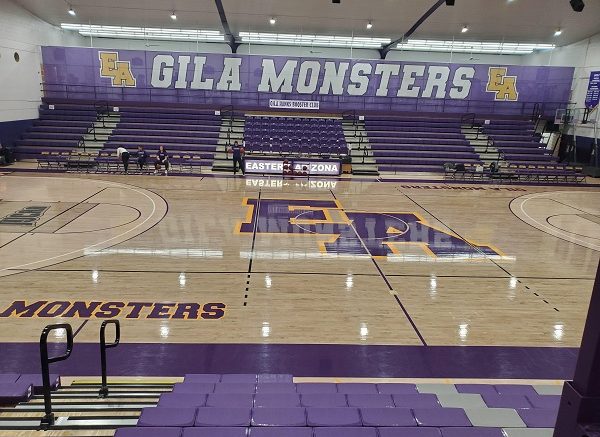
At the far edge of South Campus, down past the palms and the parking lots, sits Guitteau Gymnasium, a red-brick relic from 1963 that still looks like it was built to last through a dust storm. Named for Paul E. Guitteau, the college president who turned Eastern into something more than a cluster of classrooms, it’s not fancy, not air-conditioned to perfection, and not remotely modern. But it’s home.
From the outside, it looks like a time capsule: thick brick walls, narrow windows, and a front door that’s seen more sneakers than sunshine. Inside, though, the floor gleams, the banners hang proudly, and the Rowdy Reptiles student section packs the bleachers like it’s March in mid-January. The place could use a few modern upgrades, sure, but then it wouldn’t be the same. It’s the imperfections that give the building its pulse: the echo off the rafters, the smell of varnish and popcorn, the way you can hear the ball bounce from outside on a cold night.
In a world where college basketball is increasingly built on transfer portals and slick facilities, Guitteau stands as the opposite. It’s a throwback, a survivor, and the beating heart of something real.
The Men: Redemption and Reloading
Last season, Cameron Turner’s men’s team won 29 games, captured another ACCAC championship, and looked every bit the part of a national contender. But one loss to Snow College in the district title game kept them from an automatic bid to the NJCAA Tournament. And somehow, despite their record and their résumé, the at-large bid never came.
“Yeah, that one stung,” Turner says. “But that’s the game. You learn, reload, and get back to work.”
Now the Monsters open the new year ranked No. 15 in the NJCAA preseason poll, and Turner’s got a roster built to make noise again. In just three seasons, he’s turned Eastern into one of the best two-year programs in the country, with 76 wins, two straight conference titles, and a national reputation built on toughness, defense, and discipline.
This year’s group might be his most balanced yet. It starts with Kahu Treacher, the 6-foot-9 forward from New Zealand who averaged 7.1 points per game and shot 44 percent from the field as a freshman. He’s the top JUCO forward in the country and already signed at Oregon State, but first, he’s got unfinished business in Thatcher.
Behind him is Ryan Hunt, the 7-footer from Perth, Australia, who played in all 31 games last season, averaging five points and four rebounds while shooting nearly 45 percent from the floor. Hunt looks stronger, leaner, and ready to own the paint.
Brad Ballinger, a 6-foot-7 forward from Shell Harbour, Australia, adds perimeter range and a soft touch that stretches defenses thin. Turner calls him “our X-factor, a shooter who can flip a game in two minutes.”
Gio Obgaidze, the 6-foot-9 sophomore from Tbilisi, Georgia, quietly shot 60 percent from the field in limited minutes last year, and Turner believes this is the season he breaks out. Kofi Peyton, the redshirt freshman guard from Seattle, brings bounce, swagger, and the kind of defensive energy that makes practices feel like game day.
And then there’s Ryder Bush, the freshman guard from East Palo Alto, California who’s already picked up four Division I offers, all before the season even tips off. He’s the kind of fearless scorer who fits perfectly in Turner’s up-tempo system: confident enough to take the big shot, humble enough to run the offense.
It’s a deep, hungry roster, part returners, part newcomers, all wired for competition. The Monsters averaged 84 points per game last year, shot nearly 50 percent from the field, and made 38.6 percent of their threes.
Turner doesn’t get caught up in the numbers, though. “We win with defense and rebounding,” he says. “Everything else comes from that.”
They’ll tip off October 31 at 3 p.m. in Guitteau Gymnasium against Gillette College, a fitting start for a team looking to turn heartbreak into redemption.
“We want the smoke,” Turner grins. “Every year, we want to prove it again.”
The Women: A New Core, Same Standard
Down the hall, Coach Angelica De Paulo has quietly turned the Lady Monsters into one of the NJCAA’s premier programs, with two straight Final Four appearances, a Region 1 title, a West District championship, and now a No. 3 national preseason ranking heading into 2025–26.
Her teams don’t just win; they overwhelm you. Last year’s squad finished 28–7, holding opponents to just 45 points per game and out-rebounding them by nearly 18 a night.
“We build on effort and accountability,” De Paulo says. “That doesn’t change no matter who’s here.”
Two starters, Eanae Dagons and Stephany Goncalves, return to anchor the lineup. Dagons, a 5-foot-4 guard from Phoenix, averaged 8.9 points per game while shooting 45.6 percent from the floor. Goncalves, the 5-foot-11 guard from Brazil, added nearly six points a game and brought the kind of defensive grit De Paulo builds her program around.
They’re joined by seven sophomores who all played under the bright lights at nationals last spring, battle-tested and hungry for more. The Lady Monsters also added Esmeralda Galindo, the Region 18 Player of the Year, a dynamic guard from Yakima, Washington, who brings scoring punch and championship experience.
And then there’s Adysen Hoopes, the local kid from Pima High School, now stepping into the same path blazed by Ashlynn Chlarson, who went from Pima to Eastern Arizona and now to the University of Arkansas.
“We’re excited to get things going and hoping to make another run,” De Paulo says, a grin breaking through that familiar laser focus.
The Lady Monsters open their season on November 6th at home against College of Southern Idaho, a matchup between two national powers that feels more like March than November.
Grit, Gold, and Guitteau
There’s a reason Guitteau Gymnasium still hums on winter nights. It’s not because of the scoreboards or the banners; it’s because this red-brick building, tucked on the far end of South Campus, has become something bigger than itself.
Every home game, the Rowdy Reptiles fill the stands until the bleachers rattle, but it’s not just the students. The whole valley turns out: parents, kids, retirees, farmers who came straight from the fields, families who’ve been sitting in the same seats for 30 years. Basketball isn’t just a campus thing; it’s a community ritual.
The gym echoes with something you don’t find much in JUCO basketball: connection, tradition, the feeling that the whole community is in it together.
Sure, the place could use some modern comforts, but then it wouldn’t be the same.
Because in Nowhere, Arizona, they’ve built something real, something lasting. A basketball culture powered by sweat, pride, and a gym that refuses to quit.
Sixty-two years later, Guitteau Gymnasium still stands. Still red-brick strong. Still shaking. Still home to a powerhouse built on grit, not glitter.