
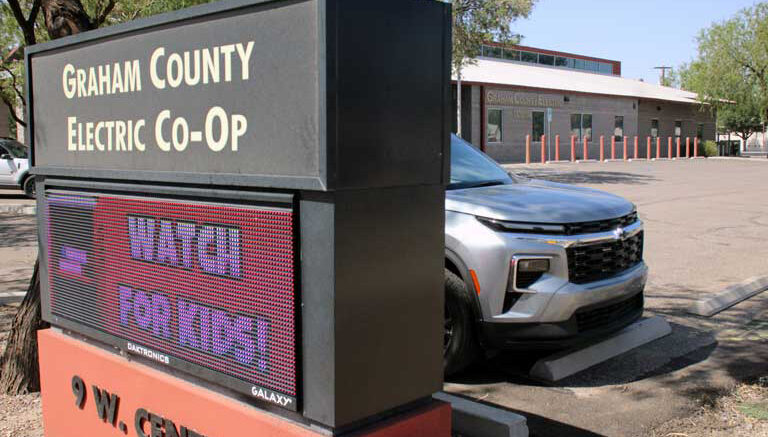


PHOENIX — The electric co-ops serving Southeastern Arizona joined together to try to ensure that residential and retail customers aren’t paying more to subsidize large users, such as data centers.
On Wednesday, Aug. 12, the Arizona Corporation Commission approved the application by Arizona Electric Power Cooperative (AEPCO) for a standardized process for approval of large-load customer agreements.
AEPCO is made up of Graham County Electric Cooperative, Duncan Valley Electric Cooperative, Sulphur Springs Valley Electric Cooperative, Trico Electric Cooperative and Mohave Electric Cooperative.
Under the agreement, any applications for large-load customers requiring Corporation Commission approval will contain the following:
- Identity the nature of the customer’s business
- Location in cooperative’s service territory
- Whether the customer will self cover any of the load (i.e., solar on site)
- Whether the load will be interruptible
- Interconnection information
- A copy of the agreement
The application did not address water usage, only the electrical power that could be supplied by the AEPCO cooperatives.
According to the application to the Corporation Commission, AEPCO members have been “receiving inquiries from large-load customers who are investigating options to locate or expand their operations in rural Arizona. These customers span a variety of industries, including industrial, manufacturing, greenhouses and data center developers.”
In October, 2025, the Cochise County Planning and Zoning Commission voted 5-3 to approve a special use authorization for a data center and solar farm in the Kansas Settlement area near Willcox.
At the meeting, applicant Louis Mouza said the data center will occupy about 1,200-square-feet, and the solar farm will use 35-37 acres of the 40-acre parcel, to power the data center. He said he hopes to expand as he’s able to acquire land.
In the application for the special use authorization, Mouza said water consumption by the data center would be “minimal” on a daily basis, while the at the Planning and Zoning Commission hearing, he estimated the facility would use “hundreds of gallons of coolant fluid with radiator and fan systems to recycle coolant while minimizing environmental impact and noise.”